
 hathach
16dbbb2b4f
make saola as cmake component, easier to add more esp32 board
hathach
16dbbb2b4f
make saola as cmake component, easier to add more esp32 board
|
6 lat temu | |
|---|---|---|
| .github | 6 lat temu | |
| docs | 6 lat temu | |
| examples | 6 lat temu | |
| hw | 6 lat temu | |
| lib | 6 lat temu | |
| src | 6 lat temu | |
| test | 6 lat temu | |
| tools | 6 lat temu | |
| .gitattributes | 6 lat temu | |
| .gitignore | 6 lat temu | |
| .gitmodules | 6 lat temu | |
| CODE_OF_CONDUCT.md | 7 lat temu | |
| CONTRIBUTORS.md | 6 lat temu | |
| LICENSE | 7 lat temu | |
| README.md | 6 lat temu | |
| changelog.md | 6 lat temu | |
| pkg.yml | 7 lat temu | |
| repository.yml | 7 lat temu | |
| tinyusb.Doxyfile | 8 lat temu | |
| version.yml | 7 lat temu |
README.md
TinyUSB




TinyUSB is an open-source cross-platform USB Host/Device stack for embedded system, designed to be memory-safe with no dynamic allocation and thread-safe with all interrupt events are deferred then handled in the non-ISR task function.
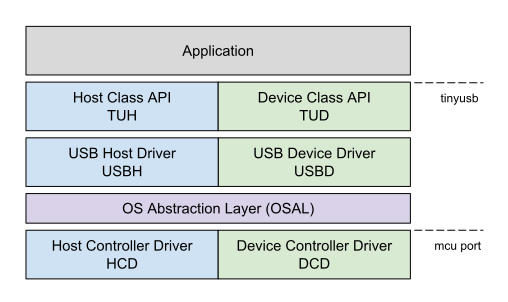
.
├── docs            # Documentation
├── examples        # Sample with Makefile and Segger Embedded build support
├── hw
│   ├── bsp         # Supported boards source files
│   └── mcu         # Low level mcu core & peripheral drivers
├── lib             # Sources from 3rd party such as freeRTOS, fatfs ...
├── src             # All sources files for TinyUSB stack itself.
├── test            # Unit tests for the stack
└── tools           # Files used internally
Contributors
Special thanks to all the people who spent their precious time and effort to help this project so far. Check out the CONTRIBUTORS.md file for the list of all contributors and their awesome work for the stack.
Supported MCUs
The stack supports the following MCUs:
- Espressif: ESP32-S2
- MicroChip: SAMD21, SAMD51 (device only)
- NordicSemi: nRF52840, nRF52833
- Nuvoton: NUC120, NUC121/NUC125, NUC126, NUC505
- NXP:
- LPC Series: 11Uxx, 13xx, 175x_6x, 177x_8x, 18xx, 40xx, 43xx, 51Uxx, 54xxx, 55xx
- iMX RT Series: RT1011, RT1015, RT1021, RT1052, RT1062, RT1064
- Sony: CXD56
- ST: STM32 series: L0, F0, F1, F2, F3, F4, F7, H7 (device only)
- TI: MSP430
- ValentyUSB eptri
Here is the list of supported Boards that can be used with provided examples.
Device Stack
Supports multiple device configurations by dynamically changing usb descriptors. Low power functions such like suspend, resume, and remote wakeup. Following device classes are supported:
- Communication Class (CDC)
- Human Interface Device (HID): Generic (In & Out), Keyboard, Mouse, Gamepad etc ...
- Mass Storage Class (MSC): with multiple LUNs
- Musical Instrument Digital Interface (MIDI)
- Network with RNDIS, CDC-ECM, CDC-EEM (work in progress)
- USB Test and Measurement Class (USBTMC)
- Vendor-specific class support with generic In & Out endpoints. Can be used with MS OS 2.0 compatible descriptor to load winUSB driver without INF file.
- WebUSB with vendor-specific class
Host Stack
Most active development is on the Device stack. The Host stack is under rework and largely untested.
- Human Interface Device (HID): Keyboard, Mouse, Generic
- Mass Storage Class (MSC)
- Hub currently only supports 1 level of hub (due to my laziness)
OS Abstraction layer
TinyUSB is completely thread-safe by pushing all ISR events into a central queue, then process it later in the non-ISR context task function. It also uses semaphore/mutex to access shared resources such as CDC FIFO. Therefore the stack needs to use some of OS's basic APIs. Following OSes are already supported out of the box.
- No OS : Disabling USB IRQ is used as way to provide mutex
- FreeRTOS
- Mynewt Due to the newt package build system, Mynewt examples are better to be on its own repo
Compiler & IDE
The stack is developed with GCC compiler and should be compilable with others. The examples folder provides Makefile and Segger Embedded Studio build support. Here are example build instructions.
Getting Started
Here are the details for getting started with the stack.
Porting
Want to help add TinyUSB support for a new MCU? Read here for an explanation on the low-level API needed by TinyUSB.
License
MIT license for all TinyUSB sources src folder, Full license is here. However, each file is individually licensed especially those in lib and hw/mcu folder. Please make sure you understand all the license term for files you use in your project.
Uses
TinyUSB is currently used by these other projects:
- Adafruit nRF52 Arduino
- Adafruit nRF52 Bootloader
- Adafruit SAMD Arduino
- CircuitPython
- MicroPython
- TinyUSB Arduino Library
Let me know if your project also uses TinyUSB and want to share.